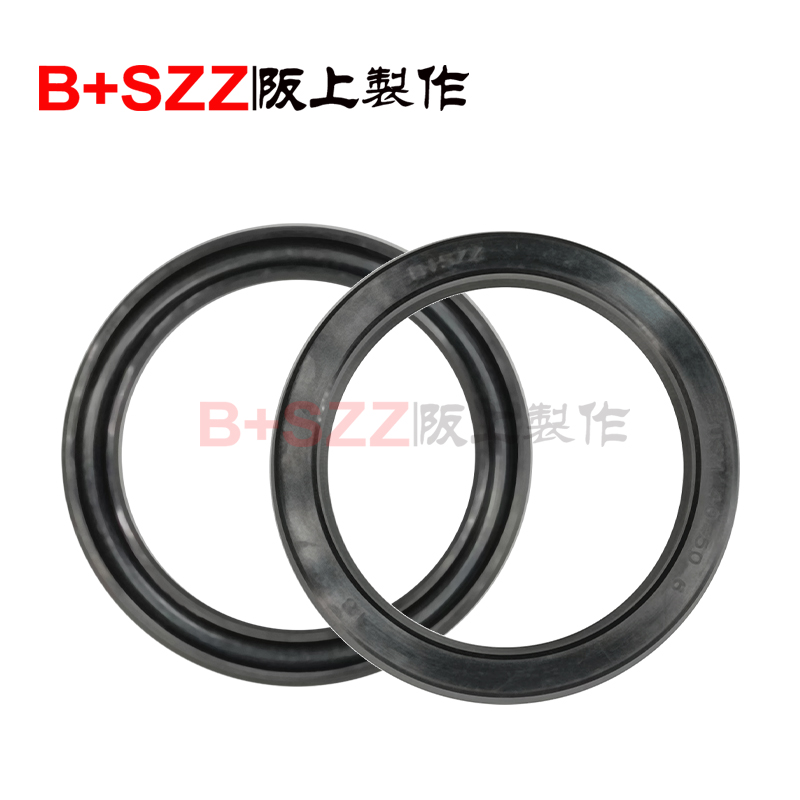
The SPGO-Type Piston Rod Seal is a groundbreaking sealing solution engineered for extreme dynamic applications characterized by ultra-high speeds, rapid pressure reversals, and violent pressure oscillations. Utilizing the patented SPGO (Self-Pressurizing Gas-Oscillating) technology, this seal features an internal oscillating gas piston mechanism that actively synchronizes with and counteracts external pressure fluctuations in real time. This creates a dynamic damping barrier, virtually eliminating seal lip flutter, maintaining stable lubrication, and preventing extrusion and wear under the most punishing conditions.
Internal Gas Chamber & Free Piston: A precisely balanced, low-mass piston oscillates within a sealed nitrogen chamber.
Real-Time Pressure Mirroring: The free piston’s position and chamber pressure directly mirror and oppose the external system pressure’s rate of change (dP/dt), not just its magnitude.
Active Damping: The oscillating mass and compressed gas act as a mechanical shock absorber, dampening pressure spikes and reversals before they can destabilize the primary sealing lip.
Primary Lip (Stability Layer): A short, stiff polyurethane lip designed for high-frequency tracking of the rod, stabilized by the constant gas pressure behind it.
Sacrificial Lubrication Lip (Flow Control Layer): Creates a controlled, metered micro-leakage path to ensure a continuous lubricant film on the rod, even at rest.
Oscillation Damper Lip (Energy Absorption Layer): A wide, low-modulus elastomer lip connected directly to the gas piston, absorbing residual vibrational energy.
Hyper-Extrusion Ring (Static Shield): A segmented, interlocking PEEK ring that only engages under extreme static pressure or during system failure.
Integrated MEMS Accelerometer: Monitors rod velocity and acceleration 10,000 times per second.
Predictive Piston Control: A micro-controller uses motion data to predictively pre-position the gas piston, achieving true phase-lock with the cylinder’s pressure cycle.
Adaptive Frequency Tuning: The system automatically tunes the gas chamber’s resonant frequency to match the dominant oscillation frequency of the application.
| Parameter | Specification | Test Standard / Condition |
|---|---|---|
| Max Operating Speed | 15 m/s (continuous), 25 m/s (peak) | ISO 10766 |
| Pressure Oscillation | ± 50 MPa at up to 500 Hz frequency | Custom sine wave pressure test |
| Static Pressure | 0 – 100 MPa | ISO 5597-1 |
| Response Time | < 0.2 ms for 90% counter-pressure build | Step pressure response test |
| Friction Coefficient | 0.02 – 0.10 (speed-dependent, exceptionally low) | ASTM D1894 at 10 m/s |
| Leakage Rate | < 0.001 ml/min (metered lubrication flow) | |
| Operating Temperature | -40°C to +135°C (Electronics Range: -20°C to +105°C) |
| Component | Primary Material | Key Property | Purpose |
|---|---|---|---|
| Gas Piston | Titanium Alloy (Ti-6Al-4V) | High stiffness-to-mass ratio | Core oscillating element |
| Gas Chamber Body | 17-4PH Stainless Steel | Fatigue resistance, hermeticity | Contains high-pressure nitrogen |
| Primary Seal Lip | TPU (98 Shore A) | High resilience, low hysteresis | High-frequency rod tracking |
| Damper Lip | Silicone Rubber | High damping coefficient | Energy dissipation |
| Control Board | High-Temp FR4 | Vibration resistant | Runs control algorithms |
Servo-Hydraulic Fatigue Testers: For materials/components testing with high-frequency load cycles.
High-Speed Automation: Pick-and-place robots, stamping presses with very short cycle times.
Aerospace Actuation: Flight control surface actuators in fighter jets, experiencing rapid maneuvering loads.
Ballistic/Recoil Systems: Artillery recoil mechanisms with extreme pressure rise times.
Fluid Power Research: Test rigs for studying dynamic seal behavior under controlled oscillations.
Digital Hydraulic Pumps/Motors: Systems using high-speed valve switching for control.
Rod Dynamics: Straightness ≤ 0.05 mm/m, surface finish Ra ≤ 0.1 µm. Absolute must for high-speed function.
Power & Signal: Requires a low-voltage DC supply (12-24V) and provides a digital status/output signal.
Calibration: Each seal must undergo a 10-minute automated calibration cycle on first installation to tune its algorithm to the specific cylinder’s characteristics.
Mechanical Installation: Use the provided cone tool. Ensure the data/power port is accessible.
Electrical Connection: Connect to power and optional CAN bus or analog output.
System Calibration: Initiate calibration mode. The seal will perform a series of micro-oscillations to map system response.
Operational Verification: Monitor the provided status LED or signal to confirm “phase-lock” achieved.
Piston Position Feedback: Continuously monitors the gas piston’s central position; drift indicates gas loss or seal wear.
Phase Error Tracking: Measures the microseconds of delay between system pressure change and piston response.
Performance Logging: Stores histograms of operating speed, pressure, and temperature.
The control algorithm detects changes in system damping (a sign of fluid aeration or viscosity change) and increased force required to move the piston (a sign of lip wear or contamination).
Provides early warnings for system issues beyond the seal itself.
Rechargeable Gas Reservoir: The nitrogen charge is rated for 5 years but can be recharged in the field via a proprietary high-pressure port.
Electronic Module: The control board is potted but replaceable as a unit.
Seal Life: The primary wear indicator is the phase error value. End of functional life is declared when this error exceeds a calibrated threshold, not simply when leakage begins.
Unmatched Dynamic Stability: Eliminates seal chatter/flutter at high speed, the primary cause of failure in conventional seals.
Active, Not Passive: Doesn’t just withstand pressure oscillations; it actively fights them with a synchronized counter-force.
System Health Sensor: Acts as a sophisticated diagnostic probe for the entire hydraulic cylinder.
Enables New Machine Designs: Allows engineers to design for higher speeds and faster cycles previously limited by seal technology.
Reduces Total Cost of Ownership: Prevents catastrophic failures, reduces downtime, and provides predictable maintenance scheduling.
Engineering Commentary: The SPGO is not merely a seal; it is a mechatronic system for the fluid power interface. Its development was driven by the limitations of passive materials in the face of extreme dynamics. Success requires treating it as a system component with electrical and control needs. It is the definitive solution where